Position · the edge side of the book
Bot economics on Betfair Poker
A poker bot is only worth running where its expected value clears the rake and survives the field. On the iPoker Network behind Betfair Poker, that window is narrow and stake-dependent. This page prices it: what edge a solver-anchored agent realistically holds, what rake eats, and where the curve turns negative.
The single equation
Strip away the marketing and a bot's profit is one expression: realised win rate, minus rake, minus the cost of detection risk, multiplied by the volume the liquidity allows. Each term pulls in a different direction across stakes, which is why there is a band that pays and a band that does not — rather than a flat "bots win" or "bots lose."
- Win rate (edge). A well-built agent anchored to GTO solver output earns most against weak fields and almost nothing against other strong, balanced players. Edge falls as the field toughens.
- Rake. A fixed tax on every pot. As a fraction of a thin edge it is brutal at micro stakes and negligible at high stakes.
- Detection cost. The expected loss from bans, fund holds, and burned accounts. It rises with stake because scrutiny concentrates where the money is.
- Liquidity. The number of beatable tables running at once. On a mid-size network this caps how much volume — and therefore total profit — a bot can put through.
Stake-by-stake: where the rake bites
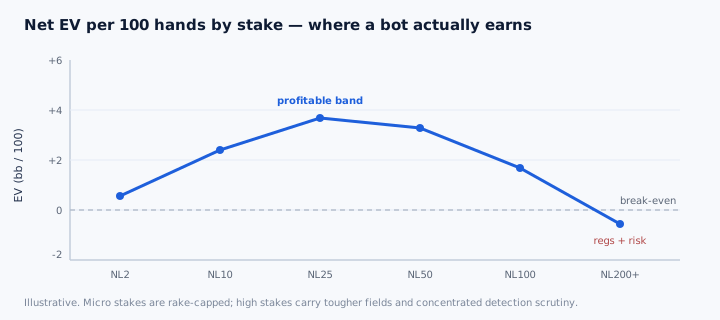
The table below traces a competent agent across Betfair Poker's no-limit hold'em ladder. Win rates are expressed in big blinds per 100 hands (bb/100) — the standard unit — and are illustrative of a strong but not superhuman model against typical iPoker fields. Rake is shown as the effective drag once the network's pot cap is accounted for.
| Stake | Field softness | Gross edge | Rake drag | Net before risk | Verdict |
|---|---|---|---|---|---|
| NL2 | Soft | +9.0 | -8.4 | +0.6 | Rake kills it |
| NL10 | Soft | +7.5 | -4.2 | +3.3 | Earning band |
| NL25 | Medium | +6.0 | -2.4 | +3.6 | Sweet spot |
| NL50 | Medium | +4.5 | -1.5 | +3.0 | Still works |
| NL100 | Tough | +2.0 | -1.0 | +1.0 | Thin |
| NL200+ | Very tough | -0.5 | -0.7 | -1.2 | Loses to regs |
Two cliffs frame the band. At the bottom, the rake is a near-flat tax that an edge of a few bb/100 cannot outrun — micro stakes look soft but pay almost nothing net. At the top, the "gross edge" itself goes negative: high-stakes iPoker regulars are themselves studying solver output, so the bot no longer holds an advantage and the rake simply finishes the job. The money lives in the middle, where fields are still exploitable and the rake has shrunk relative to the pots.
Rake on the iPoker Network
iPoker uses weighted-contributed rake with a per-stake cap, the standard model for licensed cash games. The headline percentage matters less than the cap: at micro stakes the cap is rarely reached, so a bot pays close to the full percentage on every pot it contests. As stakes climb, pots routinely exceed the cap, so the effective rake as a share of the pot falls. This is the mechanical reason the EV curve climbs out of the micro stakes before the field strength drags it back down.
Rakeback and loyalty schemes complicate this in a player's favour, but they cut against a bot operator. High-volume, high-tabling accounts are exactly the profile that loyalty analytics and detection both watch most closely — the same behaviour that earns the rebate raises the flag.
Liquidity is the hidden ceiling
Edge per hand means nothing without hands to play. Betfair Poker shares the iPoker pool, which places it well below the largest networks for peak concurrency. At the profitable mid stakes, the number of soft tables running at once is finite, and a bot that loads every available seat to maximise volume creates a second problem: a cluster of accounts with synchronised behaviour, which is the single easiest pattern for a network to detect.
So the realistic operator faces a trade-off the marketing never mentions. Spread thin across many accounts and tables to harvest liquidity, and the multi-account footprint becomes obvious. Concentrate on a few accounts to stay quiet, and the total profit is capped by how many hands a handful of seats can play. On a mid-liquidity room, that ceiling is low enough that the headline win rates rarely translate into the income the sales pages imply.
Putting a price on detection risk
Detection is not a binary event; it is an expected cost. Model it as the probability of a review multiplied by the loss when one lands — frozen balance, forfeited rake, and the replacement cost of a burned, KYC-verified account. On a UK-facing operator like Betfair that replacement cost is real: accounts require identity verification, so a banned account is not trivially recreated. Fold that expected loss into the table above and the high-stakes rows go from marginally negative to clearly unprofitable, while the mid-stakes band narrows but holds.
The arithmetic is unromantic on purpose. A poker bot on Betfair Poker is a thin-margin operation that works only in a specific stake window, against specific fields, at a volume the network's liquidity and detection jointly cap. The full risk side of that equation — which behaviours actually carry weight — is priced out on the detection page.
Want the model behind these numbers? The desk shares EV pipelines, rake math, and bankroll framing on Telegram.
Get in touch