Position · the risk side of the book
Bot detection on Betfair Poker
Bot detection on Betfair Poker is implemented as a weighted composite of behavioural signals which triggers enforcement when the aggregate score crosses a threshold. The system operates at two tiers: network-wide statistical scrutiny administered by Playtech across all iPoker skins, and operator-level KYC and account review administered by Betfair. This page describes the signals carrying the greatest weight, those carrying the least, and the interaction between the two tiers.
The two-tier model
Betfair Poker does not run its own poker engine. It is a skin on the iPoker Network, so anti-cheat operates at two levels that a bot has to clear simultaneously.
- Network tier (Playtech). The shared layer watches behaviour across every iPoker skin at once — the same hand histories, timing data, and account graph feed one detection pipeline. A pattern that looks fine on Betfair alone can stand out against the whole network.
- Operator tier (Betfair / Flutter). On top sits Betfair's own KYC, payments monitoring, and responsible-gambling checks. This tier is slower and more manual, but it controls the money: identity verification, withdrawal review, and the authority to freeze funds pending investigation.
The two tiers catch different things. The network tier is fast, automated, and behavioural — it flags how you play. The operator tier is forensic and financial — it flags who you are and how the money moves. Beating one does nothing for the other.
Reading the signal book
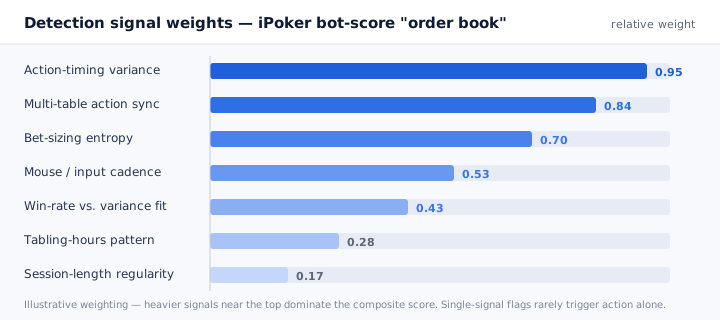
The chart above and the table below rank the signals a modern behavioural model weighs. The weights are illustrative, but the ordering reflects what is genuinely hard to fake versus what is cosmetic. The headline: the signals at the top are timing and coordination, not strategy. Detection rarely tries to prove "this play was too good." It looks for the texture of a machine.
| Signal | Weight | What it captures | Hard to fake? |
|---|---|---|---|
| Action-timing variance | 0.95 | Whether decision times vary like a human's — slower in tough spots, faster in trivial ones | Very hard |
| Multi-table action sync | 0.84 | Correlated timing or sizing across several seats run by one operator | Very hard |
| Bet-sizing entropy | 0.70 | Whether sizes cluster on solver outputs instead of the messy spread humans use | Hard |
| Mouse / input cadence | 0.53 | Movement paths, click jitter, and idle micro-motion between actions | Medium |
| Win-rate vs. variance fit | 0.43 | A win rate too smooth for the volume — too little downswing for the sample | Medium |
| Tabling-hours pattern | 0.28 | Sessions that start and stop on machine-like schedules, around the clock | Easy |
| Session-length regularity | 0.17 | Identical session durations with no human drift or fatigue | Easy |
The weighting explains why "make the bot play slightly worse" never helps. Strategic quality is not near the top of the book. The dominant signals are timing variance and cross-table coordination — exactly the things a script is structurally bad at and a multi-account operator cannot avoid. You can dump a few pots to soften a win rate; you cannot easily give a deterministic program the irregular, context-aware hesitation of a tired human across thousands of decisions.
Why timing dominates
Human decision time correlates with difficulty. People snap-fold trash, tank on close river decisions, and misclick occasionally. A naive bot acts in a tight, near-constant window regardless of the spot — and even sophisticated ones that add randomised delays tend to produce a distribution that is too clean: symmetric, stationary, and uncorrelated with board texture. Detection models the joint distribution of decision time and decision difficulty, and a machine leaves a fingerprint there that survives most attempts to add noise. This is why timing carries the heaviest weight in the book — it is the costliest signal to forge convincingly at scale.
Failure modes that get bots caught
In practice, bots are not usually caught by one elegant test. They are caught by a stack of ordinary mistakes that each nudge the composite score until it crosses the threshold.
- The fleet tell. Running many accounts to harvest liquidity creates synchronised timing, shared sizing tendencies, and a payments/device graph that ties them together. This is the second-heaviest signal for a reason.
- Sizing fingerprint. Snapping to a small set of solver-derived bet sizes produces low entropy that human play never shows; a histogram of a bot's sizes looks discrete where a human's is smeared.
- Too-smooth results. A graph with a clean upward slope and implausibly shallow downswings over a large sample is itself evidence — variance is a signature, and its absence is suspicious.
- The KYC wall. Even a behaviourally invisible bot has to withdraw. On Betfair that means identity checks, source-of-funds questions, and payment patterns that the operator tier reviews independently of how the cards were played.
- The peek myth. Hole-card readers and RNG predictors are not a failure mode because they do not work — card data is server-authoritative and encrypted, and the shuffle is a certified CSPRNG. Buying one is a way to lose money, not a way to cheat.
The honest summary: detection is a weighted, multi-signal system designed so that no single trick defeats it. The economics on the bot economics page already make a Betfair Poker bot a thin-margin operation; the detection book is the other reason the realistic ceiling is far lower than the sales pages claim.
Studying detection from the research side? The desk discusses timing models, entropy analysis, and the two-tier architecture on Telegram.
Get in touch